Call 0333 344 0070
CHECKOUT

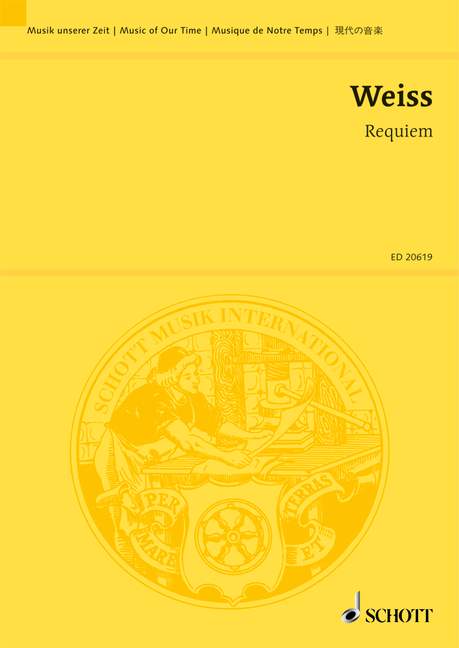
Weiss : Weiss, Harald : Requiem, Teil I: Schwarz vor Augen... · Teil II: ...und es ward Licht! - soprano, t

Weiss, Harald : Requiem, Teil I: Schwarz vor Augen... · Teil II: ...und es ward Licht! - soprano, t
Digital Edition

Weiss : Weiss, Harald : Requiem, Teil I: Schwarz vor Augen... · Teil II: ...und es ward Licht! - soprano, t

Our price: £39.99

  • Availability: Instant Download
  • SKU: 8516727
QTY

Leading Specialist Supplier

We are one of the top suppliers of woodwind, brass and orchestral strings across Sussex and are main agents for most of the instruments we sell. We only list instruments we normally carry in stock.

Full Workshop Facilities

Our instruments are fully checked and set up through our workshop to ensure perfect playing.

Expert Advice

Our team of knowledgeable staff will be only too pleased to answer any queries you have, just call us or drop us an email.

Best Prices

Our buying power enables us to sell instruments at the very best prices you will find. However, should you find an instrument cheaper elsewhere, give us a call on 01273 702444.

Buy With Confidence

All our instruments have at least a 1 year warranty, most have 2 years. We also have a 14 day return policy.

Product Specs

  • Product Number: Q7038
  • Publisher: Schott Digital
  • Arrangement: Study Score
  • Instrumentation: soprano, tenor, Knabensoprano, flugelhorn, mixed choir and chamber orchestra
  • Orchestration: 1 (auch Altfl.) · 2 (2. auch Engl. Hr.) · 1 (auch Bassklar.) · 0 - 2 · Flhr. · 0 · 0 - P. S. (Glsp. · Röhrengl. · Gongs · Trgl. · Beck. · Tamt. · 2 Holzschlitztr. (oder Woodbl.) · Woodbl. · gr. Tr.) (3 Spieler) - Org. (Positiv) - Str. (4 · 4 · 4 · 4 · 2)
  • Duration: 100\' 0\"
  • Pages: 187
  • Year of Composition: 2008 (2009)
  • Composer: Weiss, Harald
money back
free GB shipping
music rental
On letting go(Concerning the selection of the texts) In the selection of the texts, I have allowed myself to be motivated and inspired by the concept of “letting go”. This appears to me to be one of the essential aspects of dying, but also of life itself. We humans cling far too strongly to successful achievements, whether they have to do with material or ideal values, or relationships of all kinds. We cannot and do not want to let go, almost as if our life depended on it. As we will have to practise the art of letting go at the latest during our hour of death, perhaps we could already make a start on this while we are still alive. Tagore describes this farewell with very simple but strikingly vivid imagery: “I will return the key of my door”. I have set this text for tenor solo. Here I imagine, and have correspondingly noted in a certain passage of the score, that the protagonist finds himself as though “in an ocean” of voices in which he is however not drowning, but immersing himself in complete relaxation. The phenomenon of letting go is described even more simply and tersely in Psalm 90, verse 12: “So teach us to number our days, that we may apply our hearts unto wisdom”. This cannot be expressed more plainly.I have begun the requiem with a solo boy’s voice singing the beginning of this psalm on a single note, the note A. This in effect says it all. The work comes full circle at the culmination with a repeat of the psalm which subsequently leads into a resplendent “lux aeterna”. The intermediate texts of the Requiem which highlight the phenomenon of letting go in the widest spectrum of colours originate on the one hand from the Latin liturgy of the Messa da Requiem (In Paradisum, Libera me, Requiem aeternam, Mors stupebit) and on the other hand from poems by Joseph von Eichendorff, Hermann Hesse, Rabindranath Tagore and Rainer Maria Rilke.All texts have a distinctive positive element in common and view death as being an organic process within the great system of the universe, for example when Hermann Hesse writes: “Entreiß dich, Seele, nun der Zeit, entreiß dich deinen Sorgen und mache dich zum Flug bereit in den ersehnten Morgen” [“Tear yourself way , o soul, from time, tear yourself away from your sorrows and prepare yourself to fly away into the long-awaited morning”] and later: “Und die Seele unbewacht will in freien Flügen schweben, um im Zauberkreis der Nacht tief und tausendfach zu leben” [“And the unfettered soul strives to soar in free flight to live in the magic sphere of the night, deep and thousandfold”]. Or Joseph von Eichendorff whose text evokes a distant song in his lines: “Und meine Seele spannte weit ihre Flügel aus. Flog durch die stillen Lande, als flöge sie nach Haus” [“And my soul spread its wings wide. Flew through the still country as if homeward bound.”]Here a strong romantically tinged occidental resonance can be detected which is however also accompanied by a universal spirit going far beyond all cultures and religions. In the beginning was the sound Long before any sort of word or meaningful phrase was uttered by vocal chords, sounds, vibrations and tones already existed. This brings us back to the music. Both during my years of study and at subsequent periods, I had been an active participant in the world of contemporary music, both as percussionist and also as conductor and composer. My early scores had a somewhat adventurous appearance, filled with an abundance of small black dots: no rhythm could be too complicated, no register too extreme and no harmony too dissonant. I devoted myself intensely to the handling of different parameters which in serial music coexist in total equality: I also studied aleatory principles and so-called minimal music.I subsequently emigrated and took up residence in Spain from where I embarked on numerous travels over the years to India, Africa and South America. I spent repeated periods during this time as a resident in non-European countries. This meant that the currents of contemporary music swept past me vaguely and at a great distance. What I instead absorbed during this period were other completely new cultures in which I attempted to immerse myself as intensively as possible.I learned foreign languages and came into contact with musicians of all classes and styles who had a different cultural heritage than my own: I was intoxicated with the diversity of artistic potential.Nevertheless, the further I distanced myself from my own Western musical heritage, the more this returned insistently in my consciousness.The scene can be imagined of sitting somewhere in the middle of the Brazilian jungle surrounded by the wailing of Indians and out of the blue being provided with the opportunity to hear Beethoven’s late string quartets: this can be a heart-wrenching experience, akin to an identity crisis. This type of experience can also be described as cathartic. Whatever the circumstances, my “renewed” occupation with the “old” country would not permit me to return to the point at which I as an audacious young student had maltreated the musical parameters of so-called contemporary music. A completely different approach would be necessary: an extremely careful approach, inching my way gradually back into the Western world: an approach which would welcome tradition back into the fold, attempt to unfurl the petals and gently infuse this tradition with a breath of contemporary life.Although I am aware that I will not unleash a revolution or scandal with this approach, I am nevertheless confident as, with the musical vocabulary of this Requiem, I am travelling in an orbit in which no ballast or complex structures will be transported or intimated: on the contrary, I have attempted to form the message of the texts in music with the naivety of a “homecomer”. Harald WeissColonia de San PedroMarch 2009
  • Teil I: I Lehre uns bedenken
  • II In paradisum
  • III Und meine Seele spannte (Eichendorff)
  • IV Requiem aeternam
  • V Mors stupebit et natura
  • VI Selig sind die Trauernden
  • VII Libera me
  • VIII Entreiss dich, Seele, nun der Zeit (Hesse)
  • XI Und die Seele unbewacht (Hesse)
  • X Herbst (Rilke)
  • XI Lehre uns bedenken / Lux aeterna
  • Teil II: XII Sanctus
  • XIII Veni, sanctus spiritus
  • XIV Lacrimosa
  • XV Rex tremendae
  • XVI Abschied (Tagore)
  • XVII Lux aeterna
  • XVIII Der Tod, dein Diener (Tagore)
  • XIX Kann mein Auge sehen? (Weiss)
  • XX Dein Bote ist es
  • XXI Lux aeterna
  • XXII Sanctus
  • XXIII Dies Irae / Offertorium
Sample 1 : Weiss, Harald : Requiem, Teil I: Schwarz vor Augen... · Teil II: ...und es ward Licht! - soprano, t Sample 2 : Weiss, Harald : Requiem, Teil I: Schwarz vor Augen... · Teil II: ...und es ward Licht! - soprano, t Sample 3 : Weiss, Harald : Requiem, Teil I: Schwarz vor Augen... · Teil II: ...und es ward Licht! - soprano, t Sample 4 : Weiss, Harald : Requiem, Teil I: Schwarz vor Augen... · Teil II: ...und es ward Licht! - soprano, t Sample 5 : Weiss, Harald : Requiem, Teil I: Schwarz vor Augen... · Teil II: ...und es ward Licht! - soprano, t Sample 6 : Weiss, Harald : Requiem, Teil I: Schwarz vor Augen... · Teil II: ...und es ward Licht! - soprano, t

FREE UK Delivery on any order over £15!

Orchestral Instruments - Delivery is FREE within Great Britain for all instruments. The price you see is the price you pay. (Instruments over £100 are always sent by our Express service, regardless of the service selected in the checkout.)

Pianos - Delivery is FREE within Great Britain for all pianos. The price you see is the price you pay. We use a courier service and aim to have most things delivered within 3 working days.

Doorstep Drop-off only. Pianos are delivered flatpack, usually on a pallet, for self assembly. Please be aware that if you choose our courier service for larger items such as digital pianos, the courier is not contracted to carry items up any steps or stairs. If there are stairs leading to the front door of the delivery address, or you live in an apartment which is not on pavement level, it is your responsibility to arrange for transportation from the pavement level to the delivery address. Please be aware that the box can weigh 60Kg to 120Kg. We recommend that that you have help to move the box to the room of your choice from two or three able-bodied persons. In this instance, the delivery driver may, at their own discretion assist you in carrying the parcels into the delivery address, but they are not contracted nor obliged to do so.

Piano deliveries in Sussex - Subject to availability, we are often able to offer a free, pre-arranged timed delivery and setup service within 50 miles of our shops. With this option pianos are delivered and assembled in your home and the piano is left ready to play.

Sheet music, accessories & gifts - We offer 5 services:

  • Standard: £2.00 for all orders under £15.00 - FREE for all orders over £15.00 (usually 1-4 business days)
  • Tracked 24: 3.99 for all orders under 1kg - £4.99 for all orders over 1kg.
  • Tracked 48: 2.99 for all orders under 1kg - £3.99 for all orders over 1kg.
  • Express: £6.99 for all orders (usually 1 business day)

Please select your preferred option in the checkout.

Please note: Digital Sheet Music purchases do not count towards free shipping eligibility.

Instant Download

This product is as a digital item. You will receive an email with a link to download this item in PDF format

Why Buy from Ackerman?

Leading Specialist Supplier

We are one of the top suppliers of woodwind, brass and orchestral strings across Sussex and are main agents for most of the instruments we sell. We only list instruments we normally carry in stock.

Full Workshop Facilities

Our instruments are fully checked and set up through our workshop to ensure perfect playing.

4.9 Average | 11,014 Reviews
Reviews 2020 - Highest On-Time Delivery Award Reviews 2020 - Highest On-Time Delivery Award