Clarinet Care
CLARINET CARE
Thank you for purchasing/renting your instrument from Ackerman Music.
Right now, it is in good working order having been checked by our specialist repairers, but it will need a little TLC to keep it that way.
Assembling your clarinet
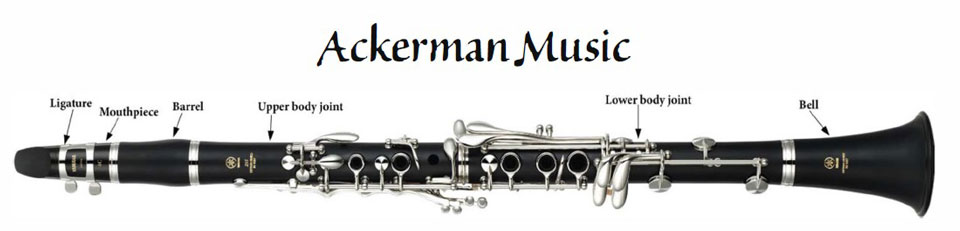
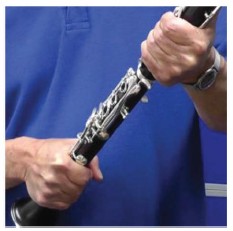
When assembling your clarinet, you first need to ensure that cork grease has been applied on all the corked joints to enable them to fit together easily. Take the two main body sections, hold the instrument where there is the least amount of key work, as shown in the picture. The left hand should hold down the ring keys so that he linkage key is raised, and then line up the 2 parts of the linkage key. Fit the barrel & bell sections. The mouthpiece will then fit onto the top of the barrel.
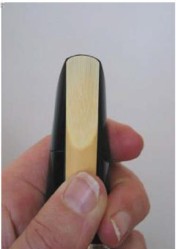
When putting a reed on your clarinet dampen it lightly then place it on the mouthpiece so that you can see a small curved black section at the top of the mouthpiece, as in the photograph. Slide your ligature over the reed, remembering to adjust the reed if it has moved, and tighten, finger tight.
Clarinet maintenance
It is advised that you clean out the instrument after each session of playing to remove moisture. Remove the mouthpiece and drop a weighted pull-through down the body from the bell end. Wipe the sockets as well. Occasionally clean the keywork with a soft cloth or silver cloth. Moisture from fingers is acidic and can tarnish the plating. Do not use any metal-polish, as this can get into the mechanism and cause it to seize. Your clarinet case will protect your instrument so always put it away safely after use. Apply cork grease occasionally. If the joints on your clarinet do not become any smoother when you have applied cork grease, please take it to a repairer as they will adjust the cork thickness for you. Clarinets should be seen by a professional repairer every 12 months for regulation, but it may need to be seen earlier if mishandling has occurred. A full service should not be required for about 3 years (depending on the amount of use). If at any point your instrument needs servicing, cleaning or repairing please bring it back to us and one of our qualified repairers will be happy to quote for you. Do not expose your instrument to extremes in temperature, like a radiator or cold garage, as this can damage the pads and the body of the instrument. Wooden clarinets are especially susceptible. These are only guidelines. Your teacher may have other suggestions.
Wooden Clarinets
The biggest cause of cracking is blowing warm air down a cold instrument. The bore warms up & expands, but the outside is still cold, does not expand and therefore cracks. Try to allow the clarinet to come to room temperature before playing. Another common problem (especially when new) is that the tenons expand from moisture. If the tenons become very tight, you need to take it to a repairer urgently, otherwise the tenons may become stuck fast or even crack the socket.


Information
Company Details
Ackerman Music Ltd (Head Office)
Unit 3, Marlborough Business Centre
Marlborough Road
Lancing
BN15 8TP
Company No. 04559582
VAT No. 620 9332 62
Payment Cards

Secure Payments